Ban Tai on Phangan is a middling beach for those who want to stay close to civilisation and aren’t planning to spend most of their holiday on the beach. There’s plenty of cheap accommodation, good amenities, it’s close to Tong Sala, and has its own supermarket and hospital.
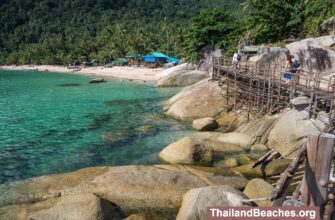
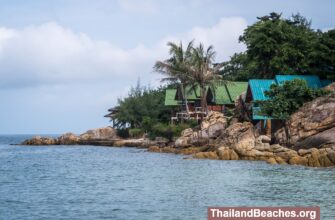
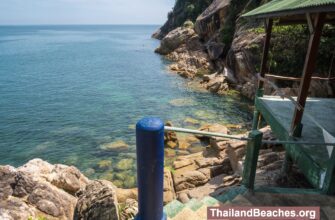
Ban Tai looks decent in good weather, especially when viewed from afar – the photos turn out fantastic. Up close however, it reveals a more complicated beauty: coarse sand with stones in the surf line, broken shells, rocky bottom, shallow water, and the shore in some areas reinforced against erosion with stone barriers.
If the sky is overcast, the beach transforms from a tropical paradise into something dreary and dull. I visited Ban Tai during the rainy season, so there’s very little colour in my photos, but during sunnier times of year the scenery here is much more appealing.
Who’s this beach for
Ban Tai attracts budget-conscious travelers who prioritize convenience and amenities over pristine beach conditions. It’s perfect for those attending Full Moon Party events but preferring cheaper accommodation than Haad Rin, and visitors who want easy access to Tong Sala’s facilities while having basic beach access.
About the beach
What makes it special
Ban Tai is located on the southwest side of Phangan. It’s one of the longest beaches on the island, stretching for about 1.2 miles (2 km). The edges of Ban Tai blend into Ban Kai in the south and Ao Ban Charu in the west.
There’s no clear boundary between these beaches either geographically or in terms of amenities. The shore extends as one continuous winding line without any headlands or rocks.
Along the shore, a road runs parallel to the beach with commercial and residential buildings occasionally interspersed with vacant lots and palm groves. The beach strip is fairly narrow, with width varying from 10 feet (3 m) to 35 feet (10 m).
The sand is mainly coarse and dark in colour with fragments of shells, corals and other debris, especially noticeable just above the surf line.
Getting in the water
Despite the shore having a decent slope, just 10 feet (3 m) from the surf line the bottom becomes very gradual. To reach a decent depth you’ll need to walk between 150 feet (50 meters) and 650 feet (200 meters).
If it weren’t for the litter on the beach, murky water and underwater rocks, Ban Tai could be called a children’s paradise. When the midday sun’s rays reflect off the bottom, they illuminate these 2 feet (0.5 m) depths with beautiful colours.
Waves
During high season there aren’t usually strong waves here. As a consequence of the shallowness, during high tide many areas of the beach become completely flooded.
In places where restaurants or resorts are close to the sea, you won’t be able to walk past them on the beach during high tide.
Loungers and shade
There are more than enough sunbeds on Ban Tai, but there aren’t any rental spots. Most loungers are set up near resorts and hotels, but there are also places where sunbeds cluster around bars.
The entire shore is covered with trees, so finding yourself a palm tree isn’t difficult, though shade on Ban Tai only lasts until noon. As you can imagine, the western side of any island has this peculiarity.
Beach photos


What’s nearby
Food and drink
Ban Tai’s amenities gradually flow into those of Tong Sala – the main port and administrative centre of the island. Tourist accommodation is concentrated by the sea, while commercial establishments are near the road.


Shopping
While near Tong Sala you’ll find everything from cash machines to supermarkets on both sides of the main road, at the other end of the area you’ll find purely tourist village amenities.
Ban Tai has Big C and Makro supermarkets and several 7-elevens.
Activities and attractions
In the centre of Ban Tai there’s a stadium and a branch of Bangkok Hospital, and closer to Ban Kai there’s a small marina for boats and vessels.
Somewhere around the middle of Ban Tai (closer to Ban Kai and Haad Rin), the infrastructure becomes much sparser. The main development is along the beachfront and near the road.
Where to stay
Ban Tai has quite a few highly-rated and pricey hotels and resorts, but there are plenty of inexpensive guesthouses too. During high season or Full Moon Party periods, you can always find a hotel on this beach.
It’s only a 20-minute motorbike or pickup truck ride to Haad Rin where the party takes place – worth noting if you’re going to the party and can’t find vacant hotels on Haad Rin itself.
There’s a large distance between the main road and the shore, so the main concentration of accommodation is right on the beachfront, with lots of vacant land beyond the road.
West, closer to Tong Sala. The beach is worse, but prices are lower:
- Sea Gate Beach Resort
- Coco Garden Resort
- The Nidhra
Centre, the best location on the beach, except for the section where there’s a stream bed:
- Summer Luxury Beach Resort & Spa
- Rung Arun Resort
- First Villa Beach Resort
South, slightly more authentic and a bit far from civilisation:
- Sunshine Residence
- House on the Beach
- Papillon Bungalows
Getting there
Since the beach stretches for about 1.2 miles (2 km), you can access the shore at multiple points. A good access point is at the very beginning of Ban Tai (on the road from Tong Sala), near Beach Resort Hacienda.
The current density of development along the coastline allows you not to worry about where they let you through to the sea without problems and where you’ll have to wave off security guards.
Beach location
Ban Tai is positioned on Koh Phangan’s southwest side, forming one of the island’s longest continuous beach stretches at approximately 1.2 miles (2 km). The beach seamlessly blends into Ban Kai to the south and Ao Ban Charu to the west, creating an uninterrupted shoreline.
Its location directly connects to Tong Sala, the island’s main port and administrative center, making it highly accessible for travelers arriving by ferry. The western orientation means morning shade but full sun exposure from midday onwards.
The beach runs parallel to the main coastal road, with most development concentrated between the road and shoreline, providing easy access to both beach and inland amenities throughout this extended coastal area.