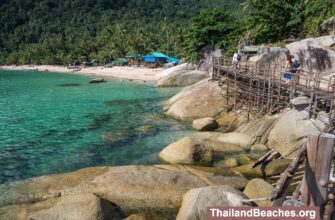
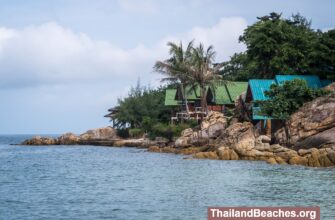
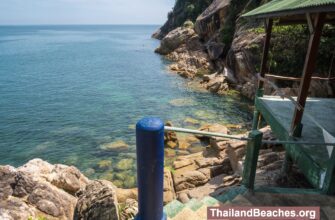
The still undeveloped eastern edge of Phangan, not yet spoiled by good roads and tourists, delights with unexpectedly beautiful and cozy beaches. Ao Thong Nai Pan Yai is one of those little beaches that hide in bays between impassable cliffs, in a small lowland at the foot of hills. The crescent-shaped shore, overgrown with lush vegetation, has been chosen by several resorts and bars. And longtail boats.
Who’s this beach for
Ao Thong Nai Pan Yai attracts travelers seeking a peaceful, extended stay away from tourist crowds. It’s perfect for those who prefer settling in for their entire holiday rather than daily visits, and appeals to visitors wanting authentic island experiences with basic amenities in a hard-to-reach location.
About the beach
What makes it special
Unlike its brother Thong Nai Pan Noi, which is literally about 350 feet (100 metres) north over the hill, Nai Pan Yai is smaller but no less attractive for beach lounging.
Ao Thong Nai Pan Yai consists of about 2600 feet (800 metres) of wide greyish-yellow sand with slight inclusions of shell fragments. When the sand dries, it becomes almost white.
During high tide, the beach width is about 70 feet (20 metres), and with low tide it reaches 130-170 feet (40-50 metres), especially at the flanks. The shore curves in an arc, has a slight slope and isn’t disfigured by wave breakers and concrete walls.
If you’re facing the sea, on the left edge there’s a river that cuts off the main beach from Cape Klang. On the right, the beach runs into Cape Tam Thong Rak.
Getting in the water
Entering the water at Thong Nai Pan Yai is very smooth. In calm weather, when there are no waves and the sea is like glass, you can clearly see the clean, stone-free bottom.
There are several large boulders sticking out in the middle of the bay, and the sea bottom becomes much shallower closer to the edges of the beach. On the right, it becomes more rocky, and on the left you’ll find lots of sand washed in by the river.
The sea depth, on average, reaches one metre at a distance of about 50-70 feet (15-20 metres) from the shore.
Waves
There aren’t any particularly large daily waves here – it’s quite a peaceful tropical beach.
Loungers and shade
The beach isn’t short of shade; trees grow along the entire shore at Thong Nai Pan Yai. After midday, the sun begins to slide behind the hills and stretch the shadows of palm trees following the receding tide.
There will only be no shade on the beach until noon – it’s the east coast, after all. Sunbeds aren’t available for rent, but they’re plentiful on hotel grounds and near restaurants.
Basically, a hundred or hundred and fifty baht for a cocktail – and you get the right to use a sunbed without time restrictions.
Beach photos


What’s nearby
Food and drink
The main road runs at a distance of 500-700 feet (150-200 metres) from the shore, so most buildings are constructed between the road and the sea. Here you’ll find resorts, bars and restaurants.
When you’re here, be sure to visit the viewpoint with a bar in the rightmost part of the beach on the hill – there’s a beautiful view from there.
Shopping
In the central and left parts of the area, the infrastructure has slightly spilled over beyond the road. You’ll find rental offices, and there’s even a 7-Eleven mini-market.
The entire micro-district of the beach is a web of very narrow concrete streets with services for tourists. Overall, the area isn’t very developed, but it’s quite suitable for a quiet, peaceful holiday.
Activities and attractions
From the centre and to the right, there’s nothing beyond the road except jungle, and buildings huddle closer to the sea. Due to its hard-to-reach location, the beach isn’t suitable for daily visits like “arrive, sunbathe, leave”.
You need to settle in properly for your entire holiday – it’ll be both more peaceful and safer that way.
Where to stay
The main residential development runs along the sea line, and only some guesthouses stand near the main road or beyond it. Unlike Thong Nai Pan Noi beach, there aren’t as many highly-rated hotels here, but there are still some choices:
- The Great Escape Chalets
- The Residence- Serviced Apartments
- Havana Beach Resort
- Dreamland Resort
- PingChan Koh Phangan Beachfront Resort
Getting there
Moving from Thong Sala along the southern shore of Phangan, you’ll reach a fork in the main road, and immediately after the merge there will be a 7-Eleven mini-market, before which you need to turn left.
Then go all the way without turning anywhere, following the signs. The road is new and wide, but has many turns and ups and downs, so don’t speed up and don’t relax.
Thai roads are dangerous because there’s always something slippery on them: leaves, sand, snakes, water or oil. When braking on sand in one of the lowlands, scooters can skid and fall over.
Beach location
Ao Thong Nai Pan Yai is located on Koh Phangan’s still undeveloped eastern edge, hidden in a bay between impassable cliffs in a small lowland at the foot of hills. The crescent-shaped beach sits about 350 feet south of its sister beach Thong Nai Pan Noi.
This remote location stretches about 2600 feet along the eastern coastline, positioned between Cape Klang on the left and Cape Tam Thong Rak on the right. The beach’s eastern orientation means morning sun exposure with afternoon shade as the sun moves behind the hills.
Its hard-to-reach position, accessible only via winding mountain roads, keeps it relatively undeveloped compared to western coast beaches, maintaining an authentic island atmosphere away from mass tourism.